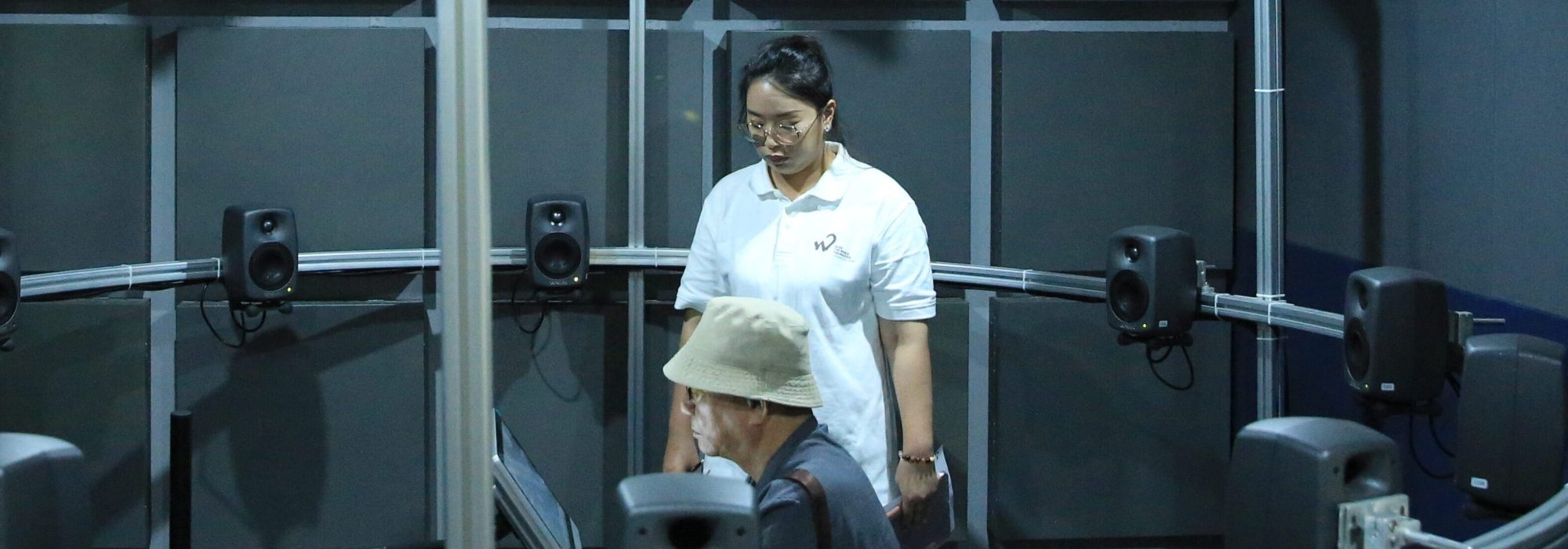
Inside the Phonak Audiology Research Center, Shanghai
A PARC series highlighting Phonak research centers worldwide, where clinical questions become clinical evidence.
Established in 2014 as part of Sonova Global R&D, PARC Shanghai was founded on a clear premise: innovation advances when research is grounded in local reality.
Also referred to as ARC Shanghai (ARC-SH), the center is based in Shanghai and provides direct access to the linguistic and cultural nuances of the Chinese market, ensuring that hearing solutions are optimized (not simply adapted) for tonal language speakers.
Led by Senior Director Eric Tian, the seven-member multidisciplinary team brings expertise in clinical audiology, hearing science, engineering, phonetics, cognitive neuroscience, software development, and AI. By feeding local insights into the global R&D pipeline, the center ensures that innovation reflects real-world listening challenges.

Center Snapshot
Location: Shanghai, China
Founded: 2014
Team Size and Disciplines: Seven specialists in audiology, hearing science, engineering, phonetics, neuroscience, and AI
Core Capabilities:
- Tonal language perception research
- 3D spatial sound field simulation
- Neurophysiological validation (EEG)
- China-centric user research
- Localized clinical validation
Why this research matters
For speakers of tonal languages such as Mandarin and Cantonese, pitch variations change word meaning entirely. Preserving tonal cues is therefore essential for accurate speech understanding.
While hearing technology performs well globally, tonal languages introduce acoustic complexities that require targeted optimization. The center focuses on ensuring that amplification supports not only audibility, but tonal discrimination, reduced listening effort, and full conversational engagement.
Inside the lab
The center operates three specialized laboratories, along with advanced neuroscience capabilities through its partnership with Shanghai Jiao Tong University.
- Audiology Lab: Semi-anechoic chamber for controlled baseline assessments
- Electroacoustic Lab: Precise hardware and software measurements
- Sonova–SJTU Joint Lab: 3D spherical sound field for realistic spatial simulations
- Neuroscience Capability: Portable EEG for real-time neural measurement
This combination enables research that balances strict experimental control with ecological validity.
The 3D sound field recreates dynamic environments such as restaurants or busy streets inside the lab, allowing advanced algorithms to be tested under realistic conditions. Meanwhile, EEG provides objective evidence that amplification supports efficient neural processing, not just improved audibility.
Evidence of excellence
The center is internationally recognized for its specialization in tonal language research. Core strengths include:
- Behavioral and electrophysiological validation of pitch-dependent speech perception
- China-centric studies examining local acoustic environments and wearing habits
- Localized clinical validation using linguistically appropriate materials
On average, the team produces approximately 10 publications, conference presentations, and study reports per year, contributing to peer-reviewed journals, trade publications, and global scientific conferences.
Key Collaborators
The center maintains partnerships with leading institutions including:
- Beijing Tongren Hospital
- West China Hospital
- China Rehabilitation Research Center for Hearing and Speech Impairment
- Peking University
- Shanghai Jiao Tong University
- The University of Hong Kong
- The Chinese University of Hong Kong
- Beijing Normal University
- Ohio University (USA)
These collaborations ensure both academic rigor and clinical relevance.
From lab to clinic
Research conducted in Shanghai provides clinicians with evidence-based guidance in three key areas:
1. Personalizing noise management for tonal languages
Research on dynamic noise cancellation supports fitting strategies that preserve tonal cues while maintaining listening comfort.
2. Demonstrating brain-level benefits
Mismatch negativity (MMN) studies show how deep neural network–based denoising restores automatic speech discrimination, supporting counseling conversations around reduced listening effort.
3. Validating real-world preference
Using ecological momentary assessment (EMA), ARC-SH confirms user preference for advanced DNN processing in complex environments, strengthening real-world confidence in technology recommendations.
Translating research into community care
To bridge research and primary care, our team partnered with Shanghai Xuhui District Huajing Town Community Health Service Center. By integrating hearing health education and a Mandarin Digit Triplet Test into community workflows aligned with WHO ICOPE guidelines, the initiative supports early screening and continuous management within accessible local care settings.
What is next

Expanding research in:
- Tonal perception and pitch discrimination
- Neural markers of listening effort
- Real-world acoustic simulation
- AI-driven personalization
- Integrated community care models
As hearing care becomes increasingly outcome-centered, the center ensures that innovation reflects linguistic diversity and real-world complexity.

Phonak Audiology Research Centers (PARC)
PARC is our global research center network dedicated to setting the highest standards in hearing aid performance testing, ensuring every innovation delivers real-world benefits for clients. With locations around the world— in the United States of America, China, Canada, and Switzerland – PARC’s global presence ensures that the diverse needs of hearing aid wearers are reflected and addressed.
Learn more at phonak.com/evidence