Inside the Phonak Audiology Research Center, Canada
A PARC series highlighting Phonak research centers worldwide, where clinical questions become clinical evidence.
Established in 2018 as the Sonova Innovation Centre Toronto and later expanded through the 2021 merger with the Unitron Audiology Validation Team in Kitchener, the Phonak Audiology Research Center, Canada operates across two locations in Ontario.
In Canada, it operates under the official name Sonova Audiology Research Centre – Canada.
Together, these teams bring nearly two decades of validation and exploratory expertise to support both early-stage innovation and product launch readiness.
Situated within one of Canada’s most densely populated regions, the center works closely with R&D teams in Kitchener and global engineering colleagues at Sonova headquarters in Switzerland. This integrated model enables research that supports Phonak, translating technical innovation into clinically meaningful outcomes.
The seven-member team includes registered audiologists and researchers with master’s and doctoral training in audiology, hearing science, and related disciplines. Their combined clinical and research experience helps ensure that investigations are both scientifically rigorous and grounded in real-world use.

Center Snapshot
Locations: Mississauga and Kitchener, Ontario, Canada
Founded: 2018 (expanded 2021 through team integration)
Team size and disciplines: Seven researchers, including registered audiologists with advanced degrees in audiology and hearing science
Core Capabilities:
- Early-phase exploratory research
- Clinical validation and claim substantiation
- Real-world and laboratory-based studies
- Neuroimaging research (fNIRS)
- Multi-site participant recruitment
- Feature development and evaluation
Inside the lab
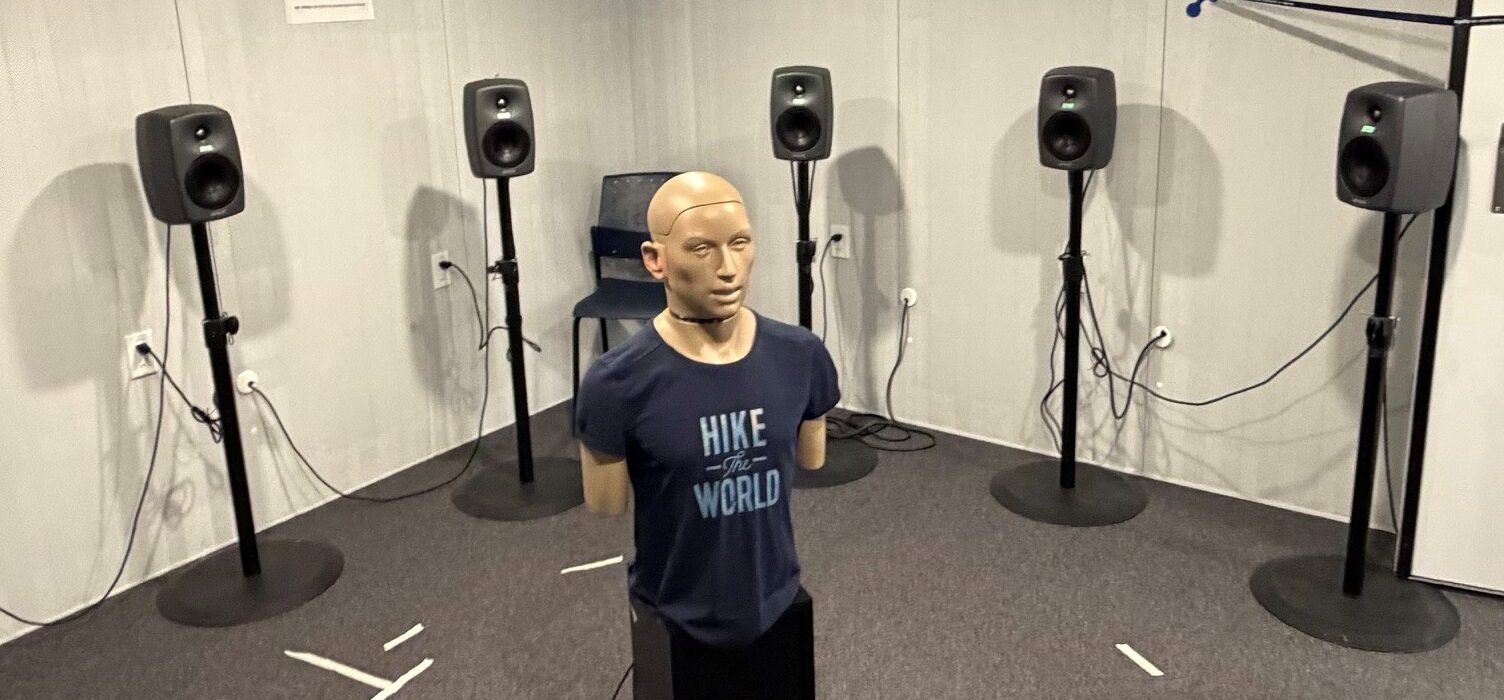
With two calibrated laboratory environments, the team can run multiple research projects of varying scope in parallel. This two-site model also broadens the participant pool. Many participants have been involved in studies over several years, enabling longitudinal insights across a diverse range of hearing profiles.
Kitchener
- Two sound booths with eight-loudspeaker arrays
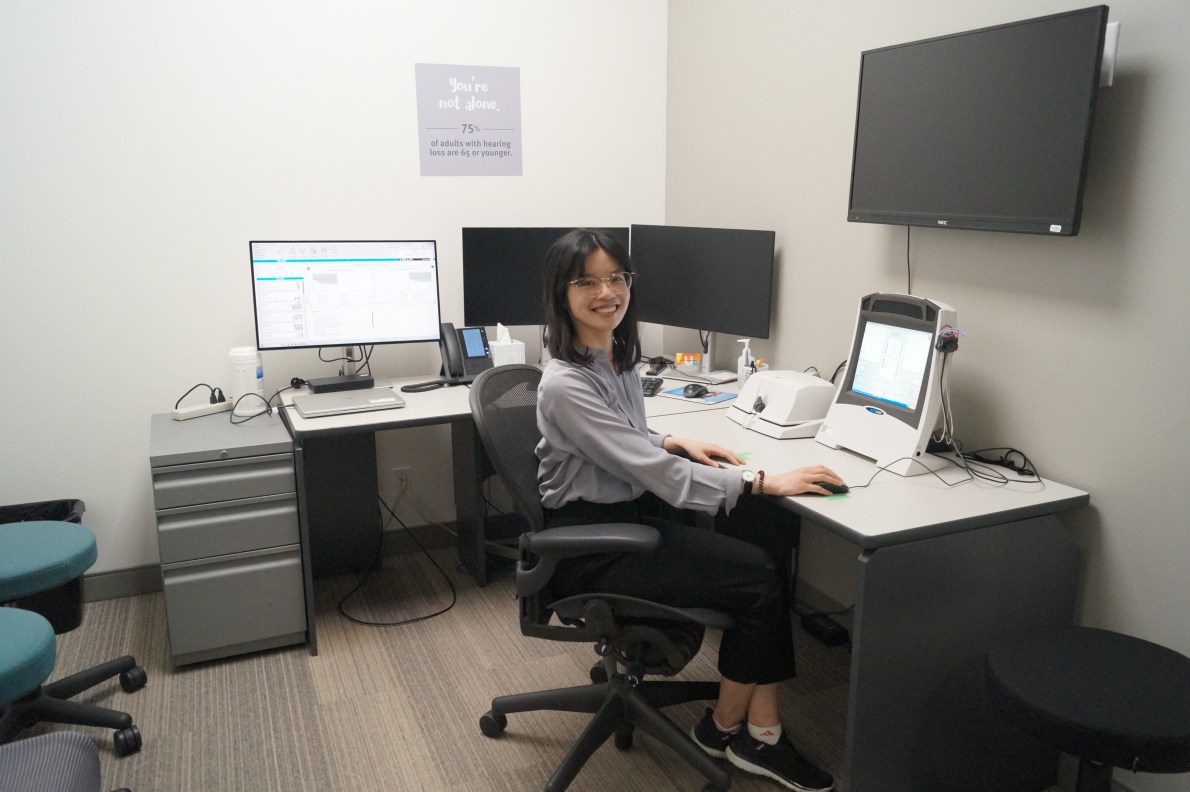
- Two large fitting areas (see Figure 1a)
- Access to a large sound booth with retractable wall for adaptable acoustic environments
As the historical Unitron headquarters, Kitchener supports validation studies aligned with product launches and clinical claim development.
Mississauga
- One fitting area
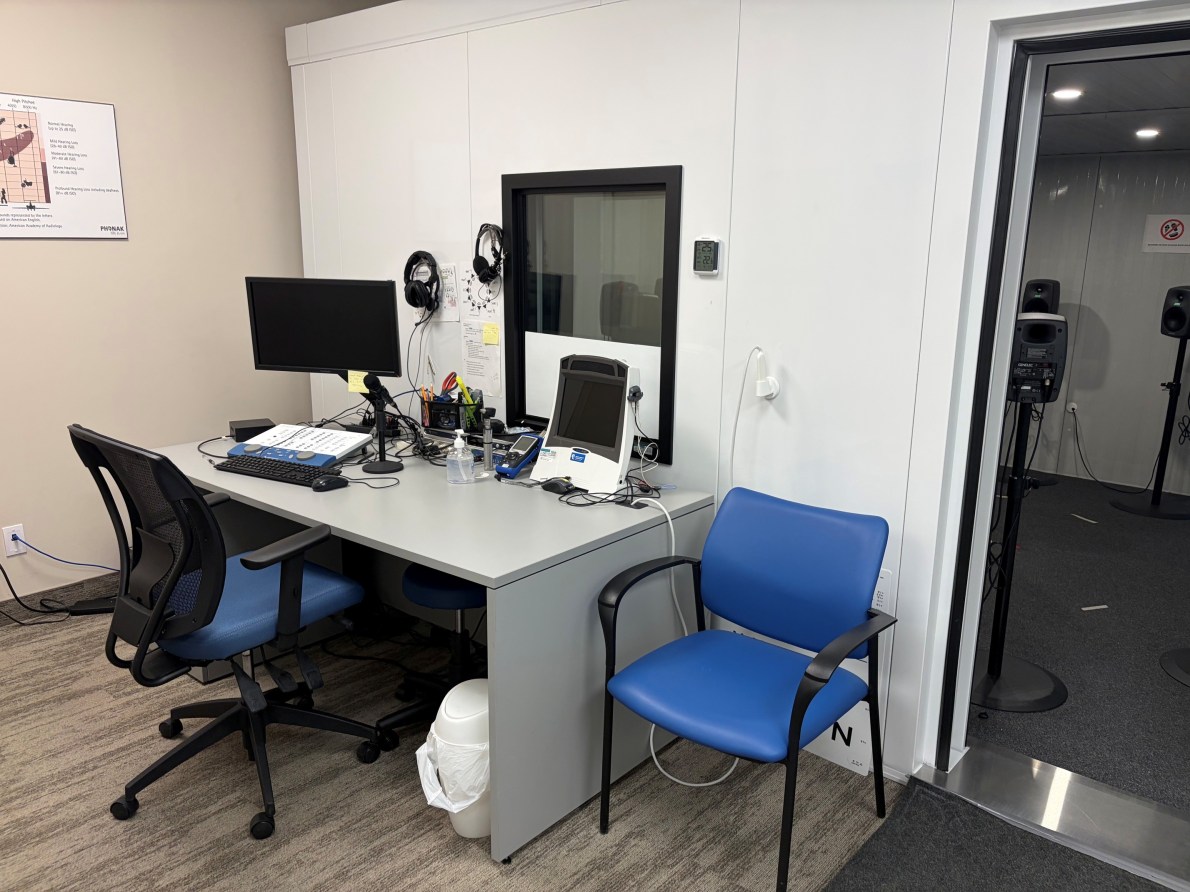
- One large sound booth with 12 loudspeakers (see Figure 1b)
The larger acoustic space facilitates evaluation of features such as directional microphones and spatial processing. The Mississauga laboratory has also hosted several studies using functional near infrared spectroscopy (fNIRS), an objective neuroimaging method used to examine listening effort.
Many participants have been involved in studies for years, allowing longitudinal insights across diverse hearing profiles.
Evidence of excellence
A core focus of the center is clinical validation. Studies evaluate whether proposed gain models, algorithms, and features deliver measurable benefits in areas such as:
- Speech intelligibility
- Sound quality
- Listening effort
- Group communication
- Cognitive function
- Environmental awareness
- Quality of life
Exploratory research often requires innovative study designs to replicate real-world scenarios within controlled laboratory settings. In some cases, research extends beyond the lab. For example, a collaboration with the University of Toronto Mississauga investigated motion sensor–based beamforming during outdoor walking tasks in real-world conditions.
The center regularly presents findings at leading conferences including the American Auditory Society Annual Scientific & Technology Conference, the American Academy of Audiology Annual Convention, the International Hearing Aid Research Conference, and the Canadian Academy of Audiology Conference.
Each year, the team publishes two to four peer-reviewed articles in journals such as Trends in Hearing, Journal of Speech, Language, and Hearing Research, and Scientific Reports.
Key Collaborators
The centre partners with respected academic and clinical institutions, including:
- University of Toronto
- Western University (London, Ontario, Canada)
- Toronto Metropolitan University
- University of Waterloo (Waterloo, Ontario, Canada)
- McMaster University (Hamilton, Ontario, Canada)
- KITE – Toronto Rehabilitation Institute University Health Network (Toronto, Ontario, Canada)
- University of Buffalo (USA)
- University of Central Florida (USA)
- Mayo Clinic (USA)
- Independent hearing clinics across North America
These collaborations strengthen methodological rigor and ensure findings remain clinically applicable.
From lab to clinic
Research conducted at these sites supports hearing care professionals in three key ways:
1. Validating technology before launch
Clinical trials ensure that hearing aids are tested by real users across meaningful listening environments prior to release.
2. Extending evidence beyond the lab
Home trials and real-world study setups generate insights that reflect everyday listening demands, strengthening confidence in feature recommendations.
3. Demonstrating objective listening effort benefits
Fundamental research using neuroimaging tools provides measurable evidence of reduced cognitive load with amplification, supporting evidence-based counseling beyond audibility alone.
Recent project spotlight
The question
Can deep neural network–based noise reduction objectively reduce listening effort?
The approach
A study conducted in Mississauga used functional near infrared spectroscopy (fNIRS) to measure oxygenation levels in the brain while participants listened with and without DNN-based noise reduction.
The key insight
Listening effort cannot be reliably measured through self-report alone. fNIRS provides objective data by measuring changes in blood oxygenation associated with cognitive load. The study demonstrated significantly lower oxygenation levels when participants used DNN-based noise reduction, indicating reduced listening effort.
What this means for hearing care
Objective neurophysiological evidence strengthens confidence that advanced noise management technologies reduce the neural cost of listening. Clinicians can reference measurable, body-based outcomes when counseling patients about the broader cognitive benefits of amplification.
What is next

Expanding research in:
- Objective measurement of listening effort
- Real-world validation studies
- Motion-based and adaptive signal processing
- Cross-border collaborative research
- Neuroimaging applications in hearing science
As hearing care increasingly emphasizes measurable outcomes and cognitive health, the center remains focused on translating laboratory evidence into clinically meaningful insights.

Phonak Audiology Research Centers (PARC)
PARC is our global research center network dedicated to setting the highest standards in hearing aid performance testing, ensuring every innovation delivers real-world benefits for clients. With locations around the world— in the United States of America, China, Canada, and Switzerland – PARC’s global presence ensures that the diverse needs of hearing aid wearers are reflected and addressed.
Learn more at phonak.com/evidence