What can brain imaging tell us about hearing aid features and listening effort?
Can neuroimaging tell us about how brain activity differs when using different hearing aid programs? Or could it show us how much cognitive demand is reduced for individuals with hearing loss when using different features during noisy listening tasks? Researchers answer this question.
Listening effort refers to the mental energy required to understand speech, especially in noisy environments. As background noise increases, so does the cognitive demand placed on individuals with hearing loss.
Measuring this effort helps us understand hearing performance in everyday situations beyond what standard audiometric tests can show.
While behavioral and peripheral physiological measures provide well-established insights into listening effort, observing brain activity adds a direct view of cognitive activity during listening.
Why focus on brain activity?
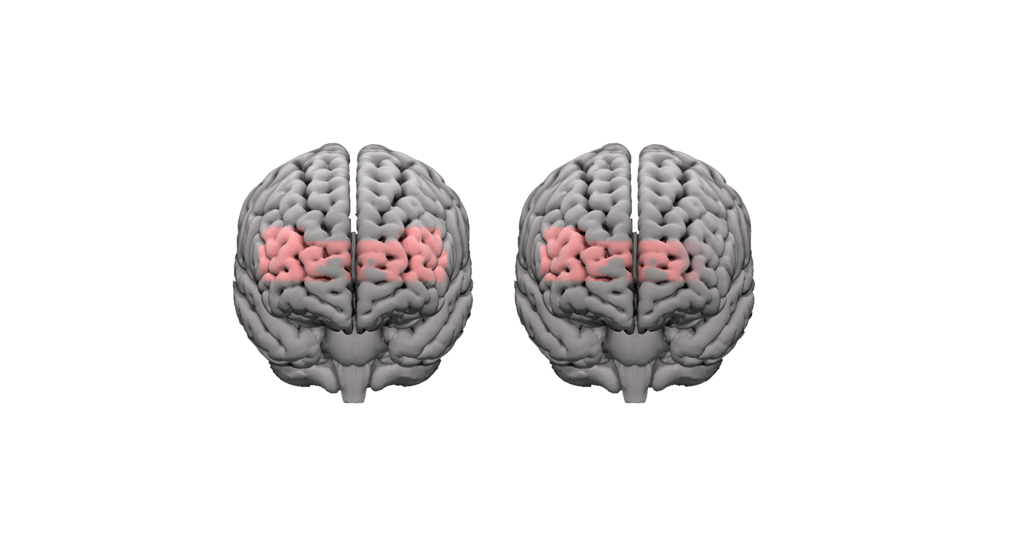
The brain’s prefrontal cortex plays a central role in managing listening effort. Studies show that greater activation in the prefrontal cortex reflects higher cognitive demands while processing speech in noise.1
In particular, the left lateral prefrontal cortex is linked to cognitive activity that reflects listening effort.
Functional near infrared spectroscopy (fNIRS) is an optical neuroimaging technique that uses infrared light to track changes in blood oxygen levels linked to brain activity. Light sources and detectors placed on the scalp measure how much oxygenated-blood concentration is present in specific brain regions, providing an indirect measure of neural activity.
Study overview: Comparing a DNN-based noise program and a standard listening program
Our research team conducted a study involving 26 experienced hearing aid users who listened to sentences presented from the front while competing noise was delivered from behind.
Two hearing aid programs available in Phonak Audéo Sphere were compared:
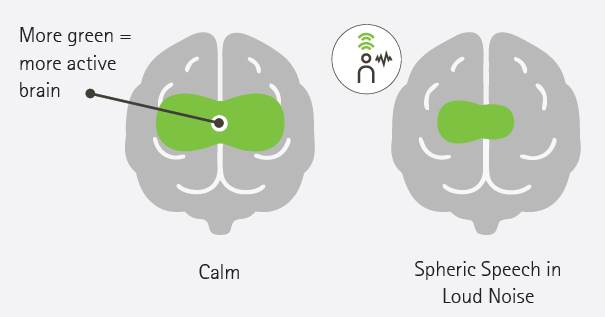
- Calm situation : Phonak’s AutoSense OS baseline program, primarily for use in quiet listening situations
- Spheric Speech in Loud Noise: Phonak’s advanced listening-in-noise program, which incorporates Spheric Speech Clarity, Phonak’s deep neural network (DNN) noise suppression technology as well as beamforming.
Participants listened to sentence sequences, repeated back key words and rated their perceived listening effort after each sequence. fNIRS recorded brain activity over three regions: the left lateral (target area), lower middle, and right lateral prefrontal cortices.
Key findings
- In a speech-understanding-in-noise task, experienced hearing aid users repeated an average 13.9% more words correctly and rated listening effort by an average of 0.94 fewer points* [on a 7-point scale] while using [Spheric Speech in Loud Noise] compared to the standard-listening program.
- The DNN-listening [Spheric Speech-in-Loud Noise] program, which combined deep neural network-driven noise reduction and directional microphone processing, led to lower oxygenation in the left lateral prefrontal cortex compared to the standard-listening program, which aligned with improved speech understanding and reduced listening effort.
These findings support fNIRS as an effective tool for characterizing changes in cortical activity that help describe how advanced signal processing features like those in Audéo Sphere translate into measurable reductions in cognitive demands during listening tasks.
Conclusion
Understanding how advanced features like Sphere DNN-based noise reduction reduce cognitive load can inform counseling discussions. Objective measures such as fNIRS offer promising a research method for evaluating device benefits beyond conventional tests.,
Moreover, integrating neuroscience insights reinforces our holistic approach toward improving clients’ overall well-being by addressing not only audibility but also cognitive demands associated with hearing loss.
In this short clip, Dr. Jonathan Vaisberg shares additional context about the study and discusses why brain-based measures like fNIRS are valuable for understanding listening effort.
We invite you to learn more in the full paper in the Phonak Evidence Library – Link
References
- Wijayasiri, P., Hartley, D. E. H., & Wiggins, I. M. (2017). Brain activity underlying the recovery of meaning from degraded speech: A functional near-infrared spectroscopy (fNIRS) study. Hearing Research, 351, 55–67. https://doi.org/10.1016/j.heares.2017.05.010