
Improving how sound is described
Why intuitive sound descriptions often fall short, and how a new research-based questionnaire aims to bridge the gap between listeners and developers.
How do you describe sound?
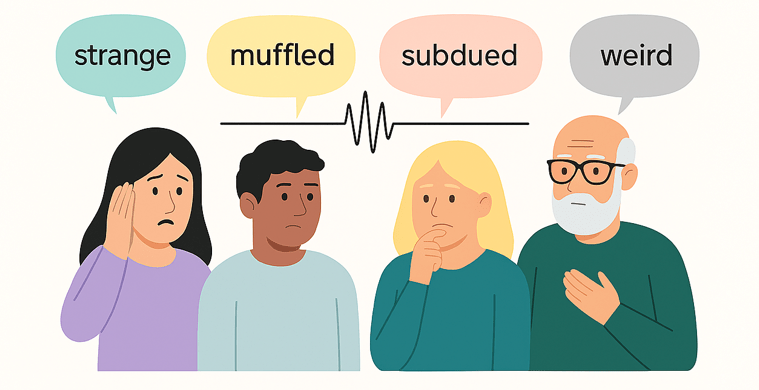
People use many different words to express what they hear: clear, warm, sharp, natural, dull, or simply “different somehow.”
In an earlier blog post about the Sound Wheel, it was demonstrated how experts analyze sound using standardized terminology. That expert vocabulary is incredibly valuable, but it isn’t intuitive for everyone. And this is where communication challenges often arise.
In everyday life, in clinics, and in product development teams, people with very different backgrounds come together. Engineers, audiologists, hearing aid wearers and study participants might all listen to the exact same sound yet, describe it in completely different ways.
A familiar scenario that reveals the core challenge
Consider a typical fitting interaction. A small adjustment is made. A speech sample is presented. The clinician asks, “How does this sound to you?”
After a pause, the response comes: “Hmm… different.” When prompted further, the description remains tentative: “I’m not sure… maybe a bit unclear? Maybe slightly muted? It’s hard to say.”
The exchange highlights a broader issue. Everyday descriptors can carry very different meanings, and it is not always clear what exactly the listener perceived or how they interpreted the change.
A similar challenge emerges in development studies. Participants are asked to evaluate how hearing aid processing alters a signal, to compare versions, or to identify subtle algorithmic effects. Yet untrained listeners rarely use the terminology familiar to sound‑quality research.
Without a shared vocabulary, descriptors vary widely.
Those working in audiology and development must infer both what listeners perceived and which aspects of the signal or processing may have produced that impression. It can then become unclear whether different individuals are referring to the same perceptual dimension or describing distinct impressions using different language.
Why we need a new kind of tool
The Sound Wheel remains an excellent and comprehensive reference for expert listeners. But in listener studies, early development phases, or large online evaluations, we face a very different reality: untrained participants, brief and intuitive feedback, subtle perceptual differences, and a wide range of expressions that do not directly map onto standardized perceptual categories.
Currently, there is no structured tool designed specifically to capture perceptual impressions from non-expert listeners while remaining analytically meaningful for developers, brief enough for study workflows, and consistent enough to support cross-study comparison.
The idea behind our new questionnaire
We are developing a structured questionnaire focused on core perceptual dimensions of sound quality. The tool is designed to capture how people perceive sound, even when they are not experts and rely on intuitive, everyday concepts rather than technical terminology.
It is short, easy to understand, and focused on the most relevant dimensions of sound perception, with versions in English and German designed to capture the same underlying concepts. It is not intended to replace expert frameworks like the Sound Wheel. Rather, it complements them, particularly in research and development contexts where untrained listeners provide feedback, including user studies, field evaluations, and early-stage development cycles.
It provides a practical, accessible instrument that helps developers understand how their algorithms sound — not just what the technical measurements say.
What this tool is meant to achieve
It might seem like a straightforward goal, but achieving it is methodologically more complex than it appears. Sound is personal, and listeners describe it in very different ways. The questionnaire aims to increase the interpretability and comparability of listener feedback. It enables listeners to articulate subtle perceptual differences without having to search for the “right” terminology.
This creates a shared foundation for communication between listeners, audiologists, and development teams, and makes results across different studies and contexts more comparable, which is essential for robust research and consistent product development.
Application in research and development
Ultimately, this work is about improving clarity in how perceptual experience is captured and interpreted. A shared language does not just make communication easier; it supports more robust decisions, stronger research conclusions, and more consistent product development.
We want people to describe sound in a way that others can understand. And we want to use that clarity to improve sound quality. In the end, better words lead to better sound, and that’s worth striving for.
Development status
We invite readers to follow the Phonak Audiology Blog for an update as this work progresses.
Co-Authors:
Julia Habicht, Audiological Researcher
Julia is an Audiological Researcher in Sonova’s Research & Development department in Switzerland, where she has been working since 2017. She is a trained hearing‑aid acoustician and studied Hearing Technology and Audiology at the University of Oldenburg, where she also earned her PhD in Neurosensory Science and Systems. At Sonova, Julia conducts clinical studies and contributes to the specification, evaluation, and refinement of audiological functionalities within the Functional Audiology Team.
Teresa Wenhart, Audiological Engineer
Teresa is an Audiological Engineer in Sonova’s Research & Development department in Switzerland, where she has been working since 2020. She has a background in neuropsychology and music perception and completed her doctoral thesis on music perception at the Hochschule für Musik, Theater und Medien Hannover and the University of Cambridge. She received the science prize of the German Society for Music Physiology and Musicians’ Medicine and also studied violoncello at the Zurich University of the Arts. At Sonova, Teresa specifies algorithms to enhance audiological performance and fitting functionalities, collaborates with audiological researchers on assessing their benefit, and facilitates workshops, retrospectives, and cross‑team collaboration.