
New evidence on Roger™ technology for adults
Adults with hearing loss often struggle to understand speech when conversations take place at a distance or in noisy environments, even with well-fitted hearing aids. A recent study investigated whether Roger technology can help overcome these everyday listening challenges.
Understanding speech can be difficult for anyone when the talker is several meters away or when background noise is present. For adults who wear hearing aids, these situations can be especially demanding because distance and background noise reduce the speech signal relative to the surrounding noise before it reaches the hearing aids. Because hearing aids can only process the signal they receive, there are some listening situations that can overwhelm even well-fit, state-of-the-art devices.
Remote microphone technology was developed to support listening in these situations by transmitting the speaker’s voice directly to the listener’s hearing aids. Much of the research in this area has focused on children because classrooms are among the most acoustically demanding listening environments, and reliable access to speech is critical for educational outcomes.
Since its introduction in 2013, Roger™ technology has demonstrated significant benefits over previous Phonak technology¹ and competitive devices². More recently, a pediatric study demonstrated significant improvements in speech intelligibility in noise and at a distance with Phonak Roger Touchscreen Microphone compared to Phonak hearing aids alone.³
Similar data in adults has been more limited. To address this evidence gap, a recent study conducted at the Phonak Audiology Research Center (PARC) in Chicago evaluated the benefit of Roger On, a remote microphone designed for adult listening needs, for speech understanding in noise and at a distance.
How was the study conducted?
Nineteen adults aged 40 to 85 years with bilateral sensorineural hearing loss participated in the study. All participants were experienced hearing aid users with little or no previous experience using remote microphone technology.
Participants were fitted with Phonak Audéo Infinio Ultra hearing aids as well as premium hearing aids from two leading brands. Real-ear verification was completed to ensure consistent fittings across all devices.
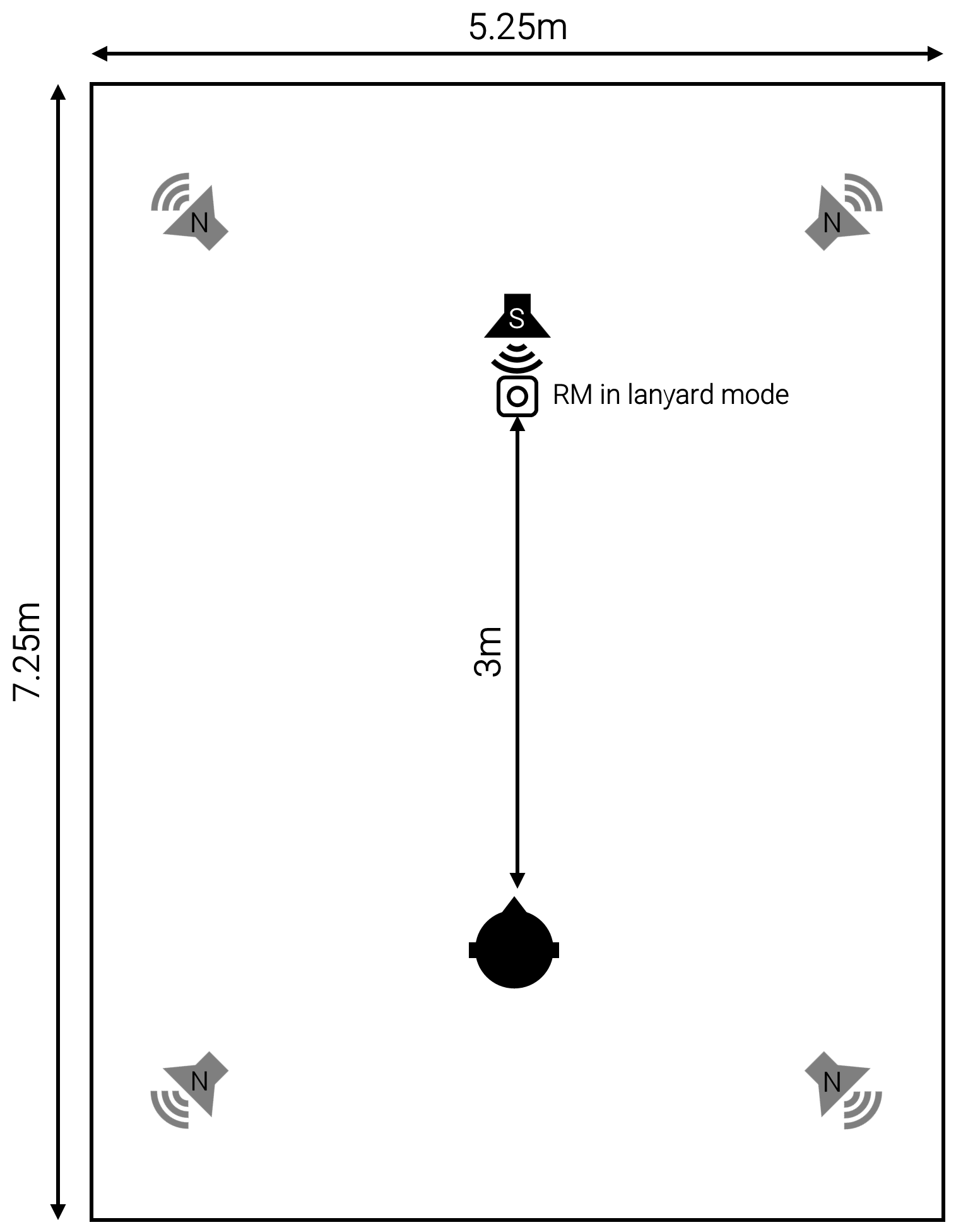
Speech understanding was measured using AzBio sentences presented from a loudspeaker positioned three meters in front of the listener under two challenging listening conditions representing moderate and high levels of background noise.
Participants were tested using four device configurations:
- Phonak hearing aids alone
- Phonak hearing aids with Roger On
- Premium remote microphone system from Brand A
- Premium remote microphone system from Brand B
Figure 1 illustrates the experimental setup. Speech was presented from a loudspeaker positioned three meters from the participant while diffuse multi-talker babble was delivered from loudspeakers positioned around the room. For the remote microphone (RM) conditions, the device was worn in lanyard mode approximately 20 cm below the speech loudspeaker.
What did we find?
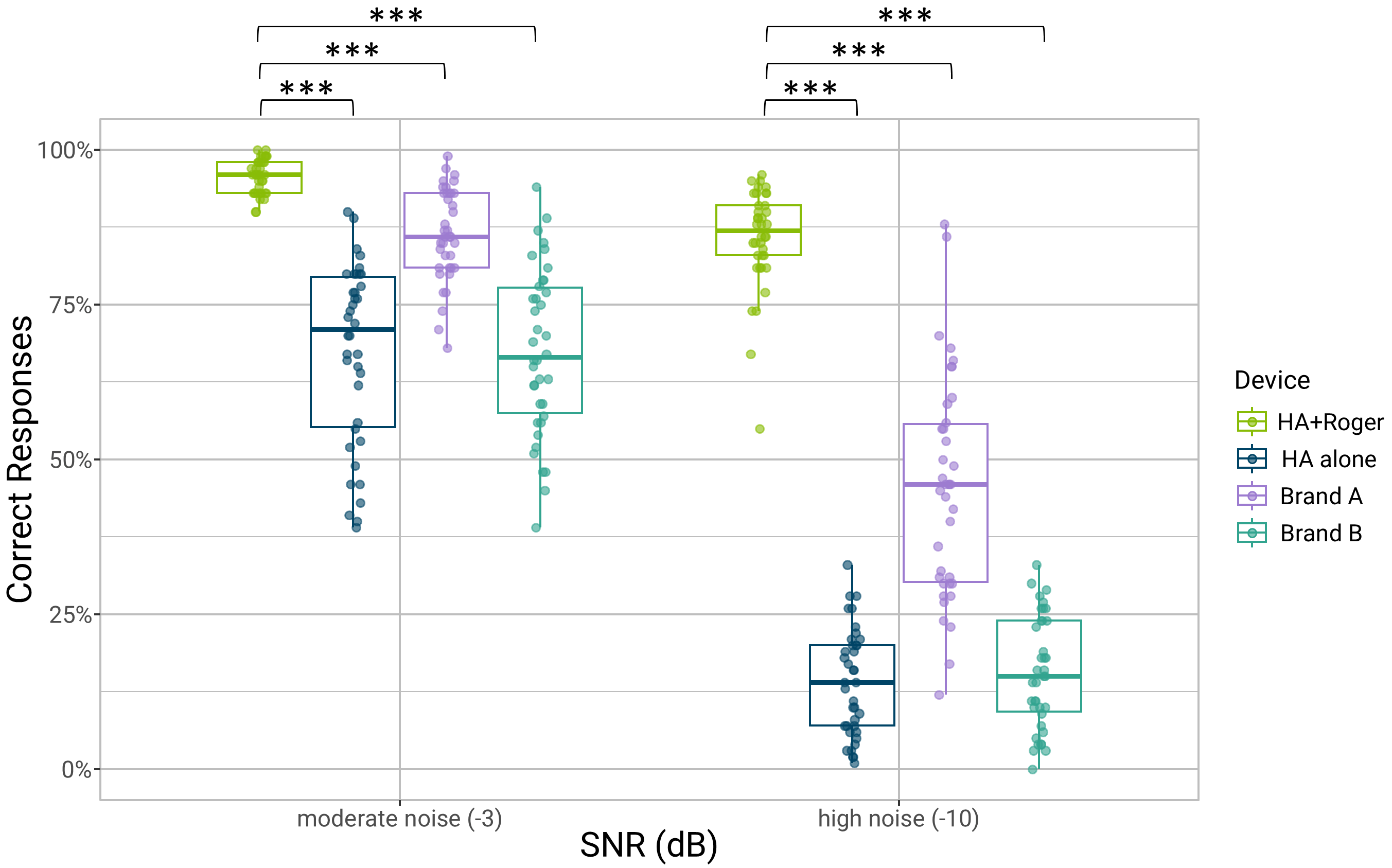
As shown in Figure 2, adding Roger On significantly improved speech understanding compared to hearing aids alone in both listening conditions.
In the moderate noise condition (-3 dB SNR), participants achieved the highest speech recognition scores when using Roger On. The advantage became even more pronounced in the high-noise condition (-10 dB SNR), where performance with hearing aids alone declined substantially while speech understanding with Roger On remained consistently high.
The study also compared Roger On with premium remote microphone systems from two leading brands. Under the conditions evaluated, Roger On consistently produced higher speech recognition scores. In the most challenging listening condition, average performance with Roger On was up to 70 percentage points higher than the comparison systems.
These findings demonstrate that the benefit of Roger technology extends beyond pediatric populations and can provide meaningful improvements for adults listening in noisy environments when speech originates from a distance.
Key findings
- Roger On significantly improved speech understanding compared to hearing aids alone.
- Benefits were observed in both moderate and high levels of background noise.
- Roger On outperformed the premium remote microphone systems from two leading brands.
- The largest differences were observed in the most challenging listening condition.
What do these findings mean for clinical practice?
Many adults with hearing loss continue to report difficulty understanding speech in restaurants, family gatherings, meetings, community events and other situations where background noise is present and the speaker is not nearby. These are common listening environments that hearing aid users encounter long after their hearing aids have been fitted.
The results of this study reinforce an important clinical principle. Even well-fit premium hearing aids cannot fully overcome the effects of distance and background noise because the speech signal has already deteriorated before it reaches the hearing aid microphones. Remote microphone technology addresses this problem by transmitting the talker’s voice directly to the hearing aids, helping to preserve a more favorable signal-to-noise ratio.
For hearing care professionals, these findings highlight the value of discussing remote microphone technology with those who continue to experience communication difficulties despite appropriate hearing aid fittings. Adults who regularly attend meetings, participate in group conversations, volunteer, attend lectures, worship services or spend time in busy social environments may benefit from the addition of a remote microphone as part of their hearing solution.
Rather than being reserved for a small group of people, remote microphones should be considered whenever distance and noise are limiting communication. Introducing this technology as part of a comprehensive hearing rehabilitation plan can help adults participate more confidently in the listening situations that matter most to them.
Looking ahead
Remote microphones have long been recognized as important technology for children in educational settings. This study adds to the growing body of evidence showing that adults can also experience substantial improvements in speech understanding when listening conditions become challenging.
As hearing care professionals continue to support adults with increasingly active lifestyles, remote microphone technology should be considered an important component of comprehensive hearing rehabilitation. The findings also reinforce the long-standing evidence supporting Roger technology, demonstrating that its benefits extend beyond the classroom to help adults communicate more successfully in everyday life.
You can find this publication on the Phonak Evidence page. Link to article is here.
References
- Thibodeau, L. (2014). Comparison of speech recognition with adaptive digital and FM wireless technology by listeners who use hearing aids. American Journal of Audiology, 23(2), 201–210. https://doi.org/10.1044/2014_AJA-13-0071
- Wolfe, J., Schafer, E. C., Heldner, B., Mulder, H., Redmond, A., Hudson, M., & Ward, E. (2015). Evaluation of performance with an adaptive digital remote microphone system and a digital remote microphone audio-streaming accessory system. American Journal of Audiology, 24(3), 440–450. https://doi.org/10.1044/2015_AJA-15-0010
- Neumann, S., Calise, S., Hill, H., Standaert, L., Schnittker, J.A., Roh, M.C., Nelson, J., & Zhu, X. (2025). Not all remote microphones are created equal: A comparison of remote microphone technologies for pediatric hearing aid users. Poster presented at: Pediatric Translational (PAT) Audiology Research Conference; Boys Town, Nebraska, NE.