
What do the 2026 WHO dementia guidelines mean for hearing care professionals?
The latest recommendations from the World Health Organization reinforce a broader, person-centered approach to hearing care. Phonak’s framework for holistic hearing care reflects this progression from hearing outcomes to broader well-being and quality of life.
Healthy aging is becoming one of the defining healthcare priorities of our time. As people live longer, there is growing recognition that maintaining cognitive, physical and social-emotional well-being requires a proactive approach across the lifespan. Hearing health is increasingly recognized as an important part of that conversation.
When the World Health Organization (WHO) published the World Report on Hearing in 20211, it highlighted the importance of making hearing care accessible throughout the life course. In July 2026, the organization released the second edition of its Guidelines on Risk Reduction of Cognitive Decline and Dementia2, further reinforcing the important role hearing health plays within a broader approach to healthy aging.
For hearing care professionals, these recommendations are reassuring. They strengthen a growing body of evidence supporting a broader view of hearing care and the outcomes we seek to achieve for the people we serve.
Looking beyond hearing
For decades, hearing care has focused on restoring audibility and improving speech understanding. These remain fundamental goals, but they are not the destination. They are the foundation.
Ultimately, successful hearing care is about helping people communicate with confidence and remain connected to the relationships and activities that matter most to them.
This philosophy is reflected in Phonak’s Holistic Hearing Care Framework, illustrated below.
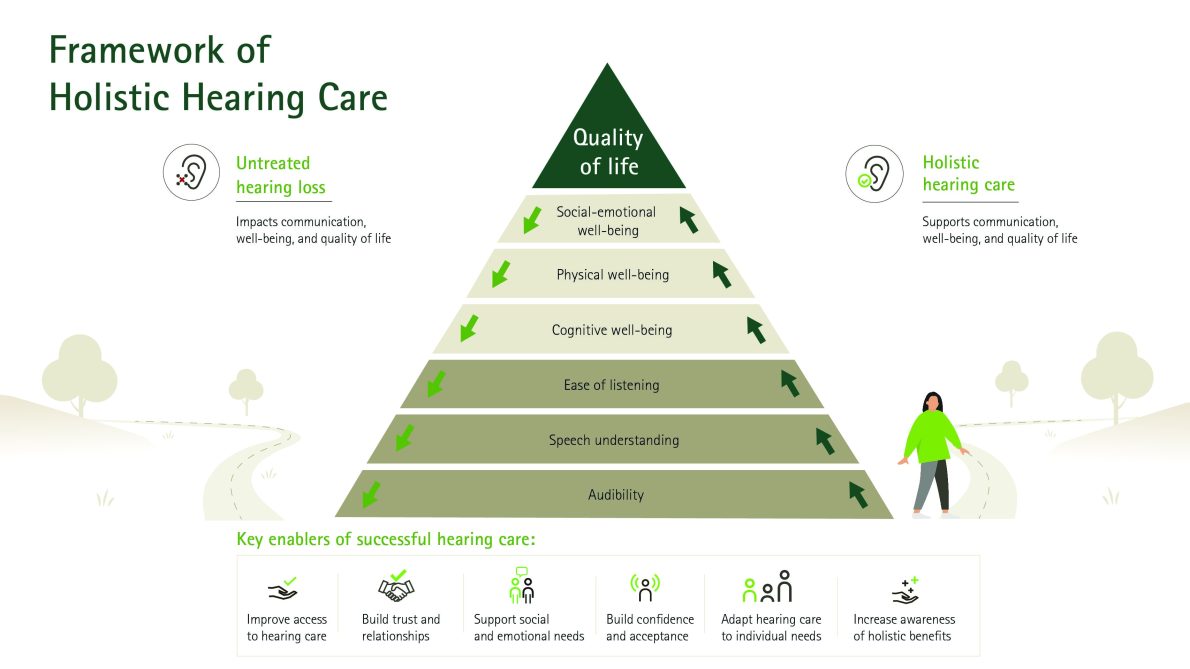
The framework builds on the foundations of hearing care: restoring access to sound and supporting speech understanding. As listening becomes easier, people are better able to engage in conversations, stay socially connected and remain active in their everyday lives.
The visual reflects this progression from improvements in communication, shown in darker beige, to the broader well-being benefits represented in lighter beige. Over time, improved hearing (and new experiences) can support physical, cognitive and social-emotional well-being. Together, these outcomes can ultimately contribute to what matters most: quality of life.
It also recognizes that achieving these outcomes depends on more than technology alone. Successful hearing care is supported by key enablers throughout a person’s hearing journey, including access to services, trust, emotional support, acceptance, physical and cognitive support, and recognition of the benefits of hearing care.
Together, these reinforce a person-centered approach that considers not only hearing needs, but the factors that can help people engage with and benefit from hearing care over time.
How does the WHO guidance support this approach?
The updated WHO guidelines estimate that up to 45% of dementia risk may be prevented or delayed by addressing modifiable risk factors throughout life. Hearing loss continues to be recognized as one of these important risk factors, and the WHO recommends preventative measures as well as timely identification and management of hearing loss as part of a comprehensive strategy to reduce dementia risk.
Importantly, the guidelines do not suggest that hearing aids prevent dementia. Rather, they recognize hearing care as one part of a broader approach to supporting healthy aging.
This recommendation reinforces a broader perspective on hearing care. Hearing care is increasingly recognized not only for improving speech intelligibility and communication, but also for its potential to support continued activity, participation in everyday life and broader well-being.
WHO 2026: Key points2
- Hearing loss should be addressed by means of prevention, screening and timely management.
- Hearing loss remains recognized as an important modifiable risk factor for dementia.
- Hearing aids are used to address hearing loss, not solely for the purpose of preventing dementia. Still, given the potential benefits, which probably outweigh the harms, the global burden of unaddressed hearing loss, and its association with dementia risk, hearing aids may be offered to adults with hearing loss, to reduce the risk of cognitive decline and/or dementia specifically.
- The updated guidelines broaden the approach to dementia risk reduction, including recommendations addressing environmental risk factors and tailored multi-domain interventions.
Bringing a holistic approach into clinical practice
For many hearing care professionals, this broader perspective will already feel familiar.
Appointments often include conversations about communication at home, confidence in different listening situations, participation in social activities and the impact hearing loss has on everyday life.
These conversations are every bit as important as measuring hearing thresholds or speech recognition scores because they help us understand what success means to each individual.
A holistic approach also encourages us to think differently about outcomes. Clinical measures remain essential. However, success should also be considered in terms of how hearing care improves people’s daily lives. It may mean enjoying family conversations again, returning to favorite activities, participating confidently in the community or simply feeling less fatigued at the end of the day.
By understanding each person’s goals and measuring outcomes that matter in everyday life, clinicians can provide care that supports both hearing and overall well-being.
Key takeaways for clinicians
- The latest WHO recommendations reinforce the importance of hearing health as part of healthy aging and the management of dementia risk.
- Holistic hearing care supports more than audibility. It promotes communication, participation and quality of life.
- Successful outcomes should be measured not only by clinical performance, but also by meaningful improvements in everyday life.
- A person-centered approach helps ensure hearing care reflects each individual’s goals, priorities and daily listening needs.
- Every appointment is an opportunity to discuss the broader benefits of hearing health and its contribution to living well.
Looking ahead
As our understanding of hearing health continues to evolve, so too does the role of hearing care professionals.
The latest WHO guidance reinforces what many clinicians have long understood. Hearing care is about helping people stay connected to the conversations, relationships and experiences that give life meaning, and may also help reduce the risk of cognitive decline and/or dementia.
The Holistic Hearing Care Framework reflects this same philosophy by recognizing that improving audibility is only the beginning. By supporting communication and helping people remain active and engaged, hearing care professionals can contribute to healthier aging and a better quality of life.
The science will continue to evolve. But one message is already clear. When we care for hearing, we are caring for the whole person.
Learn more about the latest WHO recommendations for hearing loss and other modifiable risk factors for dementia in the second edition of the Guidelines on Risk Reduction of Cognitive Decline and Dementia.
References:
1. World Health Organization (2021). World Report on Hearing. 2021. Geneva, Switzerland.
2. World Health Organization. (2026). Risk reduction of cognitive decline and dementia: WHO guidelines (2nd ed.). World Health Organization. https://www.who.int/publications/i/item/9789240123557
Authors:

Ulrike Lemke, Director Holistic Benefit & Healthy Aging, Sonova AG
Ulrike drives Sonova’s research, understanding and credible communication on the impact of hearing loss and the comprehensive value of hearing care across multiple dimensions of client benefit. She aims to apply evidence for innovative, holistic, user-centered clinical guidance, solutions, and care pathways. Supporting participation and active lifestyles across lifespans, combatting agism and promoting healthy aging through holistic hearing care is what she is passionate about. Ulrike holds a PhD in psychology, a M.Sc. in gerontology, and is a licensed clinical psychotherapist.
Lisa Bacic, Manager Global Thought Leadership, Phonak AG
Lisa works with experts across hearing care to translate evidence and professional insights into content for hearing care professionals. A speech-language pathologist and audiologist by training, Lisa has more than 15 years of clinical experience and holds a Master’s degree in Speech Pathology and Audiology.